Scenario-based learning gets talked about a lot.
Updated: May 11
But we don’t use it because it’s trendy or interactive, we use it because some skills only show up when someone has to decide what to do next. Telling someone what those skills are doesn’t stick, practicing them does.
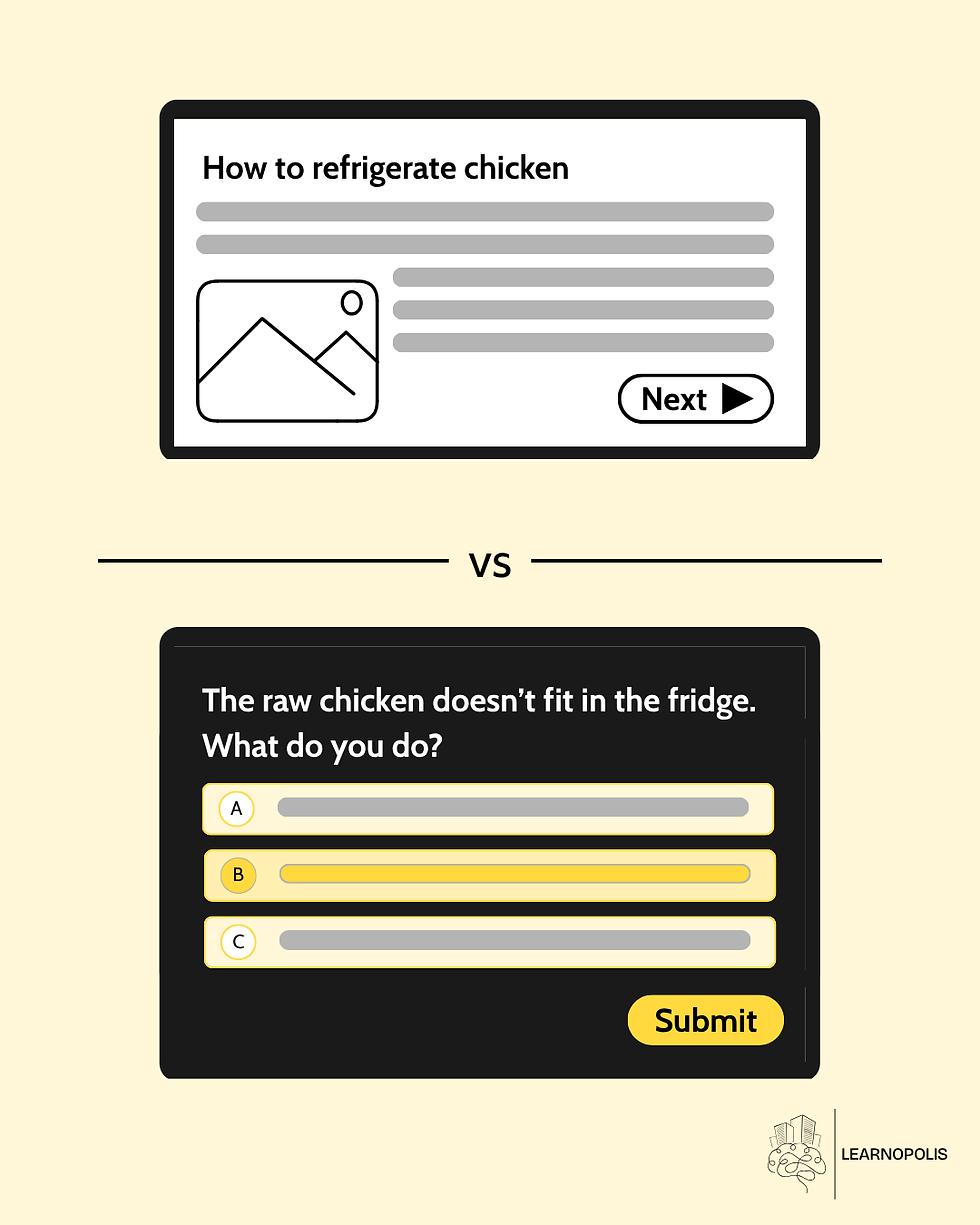
Where we see scenario-based learning fall down most often is when the scenario looks real … but the options aren’t. One answer is obviously “right”, the others are clearly wrong, or the learner is pretty much told what they should do instead of being allowed to try.
At that point, it’s not really a scenario. It’s a dressed-up content slide.
For us, there are a few non-negotiables.
All answer options need to be things a learner might actually say or do.
Feedback needs to respond to their choice, not just restate the rule.
And the scenario itself has to feel believable: close enough to real life that the learner recognises the moment.
It’s not always the right approach. If the goal is knowledge or steps, there are simpler ways to get there.
But when learners need to make decisions, especially under pressure, scenarios give them a safe place to practise judgement.
We’ve shared Streamline+ here before, so we won’t reintroduce the whole thing.
What we want to zoom in on this time is the branching. It’s intentionally simple. There are only a couple of decision points that diverge and then come back together. You can see the flow in the image.
It’s not about covering every possible outcome. Instead, the branching is built around a common tension in customer service: policy versus empathy.
Do you stick rigidly to the rules?
Do you bend to keep the customer happy?
And what does each choice do to the conversation?
Each option gets its own feedback, based on what the learner chose. There’s also optional coaching from the learner’s leader if they want support before having another go.
We kept the module deliberately short. It was built for fun and exploration, not as a full solution. In a real program, this kind of scenario would sit alongside other learning and support.
I’m curious how others approach this. When you’re designing for decision-making, how do you decide what to branch, what to keep linear, and what to leave out?
Nicola



Comments